
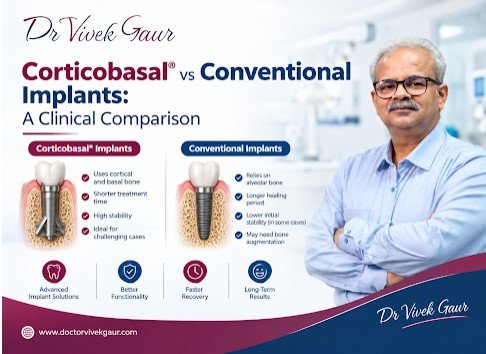
The short answer on Corticobasal® vs conventional implants is where the implant holds in your jaw. Conventional implants sit in the ridge bone that once held your tooth roots. Corticobasal® implants reach deeper, into dense bone layers. Neither suits everyone. A dentist must examine you and study your scan first.
Key takeaways
- The main difference is the bone each type uses for grip.
- Suitability depends on your bone, gum health, and medical history.
- Travelling patients should plan scans, visits, and follow-up care early.
How do Corticobasal® and conventional implants differ?
Conventional implants are titanium posts placed in the ridge. Bone slowly grows onto the surface. Dentists call this osseointegration, meaning the bone bonds with the implant.
Corticobasal® implants grip cortical bone, the hard outer layer of the jaw. Basal bone is the deeper part. It tends to remain even when the ridge shrinks.
Many basal designs are made as a fixed unit, with the post and connector joined. Conventional systems are often built from separate parts.
Who may be considered for each type?
Conventional implants often suit patients with enough healthy ridge bone. They have a long record in dentistry.
Corticobasal® planning may be considered when ridge bone is low or weak. Some patients with loose dentures or earlier implant trouble also come for review.
After a scan, selected cases may avoid extensive grafting. Grafting means adding bone material to build up the jaw.
Some complex cases need several procedures. Your surgeon should explain each step and each risk.
Side-by-side view
| Point | Conventional implants | Corticobasal® implants |
| Main grip | Ridge bone | Dense cortical bone |
| Role of bone bonding | Central to healing | Grip is mechanical from the start |
| Grafting | Sometimes needed when bone is low | May be reduced in selected cases |
| Time to fixed teeth | Often includes a healing wait | Sometimes earlier, case by case |
| Research record | Long and wide | Smaller; ask the clinic for its own records |
| Who decides | Exam and scan | Exam and scan |
What does the evidence say?
Conventional implants have decades of published research. Research on Corticobasal® and basal implants is growing but smaller. A fair clinic will say so.
Ask to see follow-up records from treated cases. Ask about the surgeon’s training in the exact system used. Ask what happens if the plan must change during treatment.
Cost varies with each case. The number of missing teeth, bone condition, and materials all play a part. Cost should not be the main reason you choose.
What should you plan before you travel to Delhi NCR?
Delhi NCR includes Delhi, Gurugram, Noida, Ghaziabad, and Faridabad. Airports, metro lines, and highways make arrival simple. Plan the medical side first.
What to plan before you travel
- Book a consultation and ask what the visit includes.
- Share old X-rays, scans, and reports before you travel.
- Ask whether a fresh scan is needed.
- List your medicines and health conditions.
- Ask how many visits your plan may need.
- Choose a stay with easy road or metro access to the clinic.
- Ask for written aftercare steps and a way to reach the team.
- Find a local dentist for routine checks at home.
Why do patients travel to Dr. Vivek Gaur?
Dr. Vivek Gaur, MDS (Maxillofacial Surgeon), PhD, has 25+ years of experience. He has successfully handled highly complex cases. Patients travel to him from across India.
Patients usually travel for expert doctors, advanced technology, and complete care in fewer visits. Experience matters most when bone is low or earlier treatment did not work.
FAQs
Are basal implants and Corticobasal® implants the same?
They are closely related. Both use dense bone for grip. Corticobasal® is a defined planning and placement approach, so ask which system your surgeon will use.
Will I need bone grafting?
Sometimes, with conventional implants, when ridge bone is low. Corticobasal® planning may reduce that need in selected cases. Your scan decides this, not a general rule.
How do I manage care after I return home?
Ask for a written aftercare plan before you leave. Keep a local dentist for routine cleaning and checks. Tell your treating team early if you notice a concern.
Choosing between Corticobasal® vs conventional implants
There is no single winner in Corticobasal® vs conventional implants. The right choice follows your bone, health, and goals. Start with a clinical evaluation, share your reports, and decide after a clear plan.
Book a consultation with Dr. Vivek Gaur.
Simpladent Clinics
4th floor, KM Trade Tower, Radisson Blu Kaushambi, Ghaziabad, India
Email: clinics@simpladent.in
This article is for general health awareness only. A formal diagnostic evaluation by a registered dental surgeon is required. Results and timelines vary by patient.


