
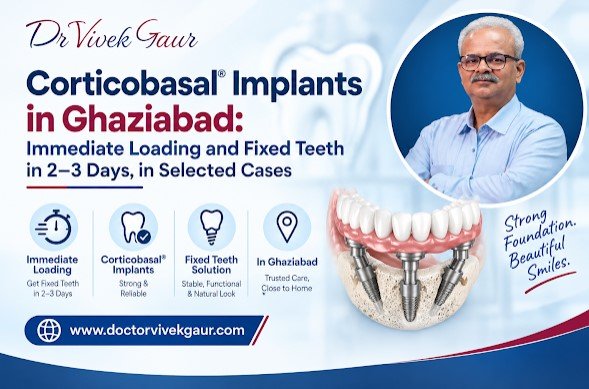
Losing teeth is hard. Waiting many months for new ones can feel even harder. For some patients, Corticobasal® implants with immediate loading implants protocols may be an option. This guide explains how the method works, what research says, who may qualify, and what to expect. It is written for patients in Ghaziabad, Vaishali, Kaushambi and nearby areas.
What Are Corticobasal® Implants?
Corticobasal® implants are dental implants that anchor in dense cortical bone, the hard outer layer of the jaw, rather than relying only on soft inner bone. Dentists join them with a rigid prosthesis, which shares chewing load and allows immediate loading implants protocols in suitable cases.
Most implants sit in softer inner bone and need months to fuse with it. Corticobasal® implants work differently. An international consensus document on this method describes them as fixed in cortical bone and meant for immediate loading. It also states that fusing with bone is not the main aim. Instead, the implants are joined by a rigid bridge.
- Grip comes from cortical bone, not only from soft inner bone.
- A joined, rigid prosthesis spreads chewing load across implants.
- Polished implant bodies are part of the described design.
- Suitability depends on your scans, bone and general health.
This design is why Corticobasal® implants are often considered when bone support is reduced, but only after a proper scan review. To see how this differs from older systems, read how two-stage implants differ.
How Immediate Loading Implants Work in the First 2–3 Days
Immediate loading implants are implants restored with teeth shortly after surgery instead of after months of healing, using rigid splinting to spread chewing forces. In suitable cases, this may allow fixed teeth within about 48 to 72 hours, confirmed after clinical and radiographic evaluation.
The clinic describes a short sequence. Exact steps depend on your case.
- Surgery: loose or infected teeth are removed if needed, and implants are placed.
- Same day: measurements are taken for your new teeth.
- Laboratory: the in-house lab designs the prosthesis.
- Fitting: the prosthesis is fixed on the implants and your bite is adjusted.
- Timing: about 48 to 72 hours in suitable cases. Results and timelines vary.
Fixed teeth in 2–3 days are possible only when the implants are stable enough on the day. Your surgeon confirms this during surgery. The clinic’s centre page lists a TRIOS 5 wireless scanner among its tools; see the clinic’s diagnostic technology.
What the Research Says About Corticobasal® Implants
Simpladent lists peer-reviewed papers on its publications page. Three matter most for patients.
- Consensus: an International Implant Foundation consensus document (Annals of Maxillofacial Surgery, 2020) describes 16 clinically used methods for placing Corticobasal® implants. Dr. Gaur is a listed author.
- Five-year data: a five-year retrospective study in the same journal reported 97% survival of immediately loaded implants. Ceramic prostheses did better than metal-acrylic ones.
- Health conditions: a 2021 study in Annals of Maxillofacial Surgery followed patients with advanced gum disease, controlled diabetes and regular smoking. Satisfaction after Corticobasal® implants stayed high in every group. It measured satisfaction, not implant survival.
- Limits: these are mostly retrospective or observational studies, and several authors are linked to the International Implant Foundation. The sources reviewed here include no randomised trial against conventional implants. Your result may differ.
Evidence looks encouraging, but it does not promise any single outcome.
Who May Be a Candidate for Immediate Loading Implants
Only a clinical exam and scans show who may qualify. These are the usual talking points.
- May be evaluated: people with missing or loose teeth, or with reduced bone support where other plans need grafts, subject to diagnostic imaging.
- Earlier implant concerns: these require detailed evaluation before deciding on retreatment.
- Needs extra care: uncontrolled diabetes, active infection, heavy clenching or grinding, earlier jaw radiation, or very thin cortical bone.
- Smoking and gum disease: both are known risk factors for conventional implants. Your surgeon will discuss how to manage them.
Every patient is assessed individually. For a real example, see a case study on limited bone.
Dr. Vivek Gaur and Dental Implants in Ghaziabad
Consultations are led by Dr. Vivek Gaur, MDS ( Maxillofacial surgeon), PhD at Simpladent Clinics, 4th floor, KM Trade tower, Radisson Blu Kaushambi, Ghaziabad, India. The clinic’s profile describes a focus on complex cases. These include bone loss, earlier conventional implants that failed, and full mouth rehabilitation. If you live in Vaishali or Kaushambi, the clinic is nearby.
- Medical history and current health review.
- Clinical examination of teeth, gums and bite.
- Radiographic imaging to study bone.
- Discussion of options, limits and timelines.
Read more about Dr. Gaur’s clinical approach. A consultation-first plan keeps choices clear before any surgery.
What Affects the Cost of Immediate Loading Implants in Ghaziabad
Cost differs for every patient. No figures are given here because a fair estimate needs an exam.
- Number of missing teeth.
- One jaw or both jaws.
- Bone density.
- Implant system used.
- Prosthesis material.
- Imaging needs.
- Medical complexity.
See what affects full-mouth implant cost, then ask for an exact estimate in consultation.
FAQs
Q1. How do Corticobasal® implants differ from conventional implants?
Conventional two-stage implants usually rely on inner bone and months of healing before teeth are fitted. Corticobasal® implants are designed to grip dense cortical bone and carry a joined prosthesis early. Which design fits you is decided after scans, bone and health review.
Q2. Can I get fixed teeth in 2 days?
In suitable cases, immediate loading implants may allow fixed teeth in about 48 to 72 hours. This depends on implant stability during surgery, bone and general health. Timelines vary. Your surgeon confirms this after clinical and radiographic evaluation.
Q3. Can I have Corticobasal® implants if I have low bone?
Advanced protocols such as Corticobasal® implants may allow patients with reduced bone support to be evaluated without extensive grafting, subject to diagnostic imaging. Some cases still need other steps. A scan review shows which applies to you.
Q4. Do diabetes or smoking rule out treatment?
Not automatically. A 2021 study found high satisfaction after Corticobasal® implants in patients with controlled diabetes, smoking and gum disease. It did not measure survival. Your surgeon reviews your health and how well these conditions are controlled.
Q5. How much do immediate loading implants cost?
Cost depends on missing teeth, one or both jaws, bone density, implant system, prosthesis material, imaging needs and medical complexity. An exact estimate needs a consultation.
Q6. Will the implants last?
Implants may offer a stable, long-term option depending on hygiene, bone volume, prosthetic design and general health. Regular check-ups matter.
Start With a Clinical Evaluation
Consult Dr. Vivek Gaur, MDS ( Maxillofacial surgeon), PhD at Simpladent Clinics, 4th floor, KM Trade tower, Radisson Blu Kaushambi, Ghaziabad, India. Bring past X-rays and medical reports. Book a consultation to discuss your implant options.
This article is for general health awareness only. A formal diagnostic evaluation by a registered dental surgeon is required.


