
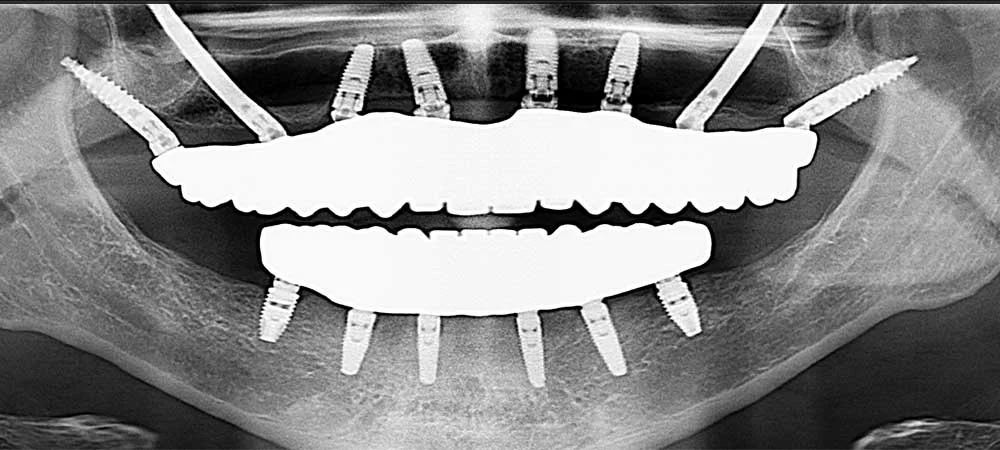
In many full-arch and posterior maxillary cases, conventional implants struggle due to lack of bone support, sinus pneumatization, or difficulties in grafting. Pterygoid implants offer a powerful solution by anchoring into the dense pterygoid apophysis (a complex of the maxillary tuberosity, palatine bone, and pterygoid process) to deliver excellent posterior support and eliminate distal cantilever zones. As reported in a 2022 study co-authored by Dr. Vivek Gaur, pterygoid implants engage the apophyseal bone and reduce dependency on the tuberosity itself, thereby enhancing stability in challenging anatomical situations.
How Do Pterygoid Implants Offer Stability in Complex Restorations
- Apical Cortical Anchorage: Rather than relying on weak crestal bone, the implant reaches apically into the highly mineralized pterygoid pillar, ensuring a dense bone–implant interface.
- Avoidance of Cantilever Forces: By placing implants more posteriorly, prostheses avoid long unsupported spans, thereby reducing mechanical stress and improving load distribution.
- Bypassing Grafting Needs: In atrophic posterior maxillae, pterygoid implants often eliminate the need for bone grafts or sinus lifts – thus simplifying the treatment and reducing failure points.
- Flapless and Minimal Invasiveness: Many pterygoid placements are done flapless, using long pathfinder drills and guided trajectories, preserving soft tissues and reducing trauma.
- Cross-Arch Stability: When splinted with anterior implants across the arch, pterygoid implants enhance the rigidity and longevity of full-mouth prostheses, even in compromised bone cases.
Because of these advantages, pterygoid implants are regarded as a strategic tool in advanced implantology – especially in full-mouth restorations where posterior support is critical. These are also suitable for single-tooth implants, especially where traditional implants fail.
Dr. Vivek Gaur – Specialist in Pterygoid Implants
As an internationally recognized implantologist, Dr. Vivek Gaur leads India in applying advanced techniques such as zygomatic and Pterygoid Implants to solve complex clinical challenges. He co-authored a technical article titled “Multiple Pterygoid Approach: A Novel Technique with Single-Piece Implants”, which details how single-piece implants can be directed toward the pterygoid apophysis to avoid cantilevers and maximize bone contact. At his center, patients who were told “no bone” now receive stable posterior support without sinus procedures. Through his work, full-mouth restorations in Ghaziabad and Delhi NCR gain posterior strength, resilience, and long-term predictability using pterygoid anchorage.
Keep Yourself Updated By Following Our Social Page for The Latest News and Information.


