
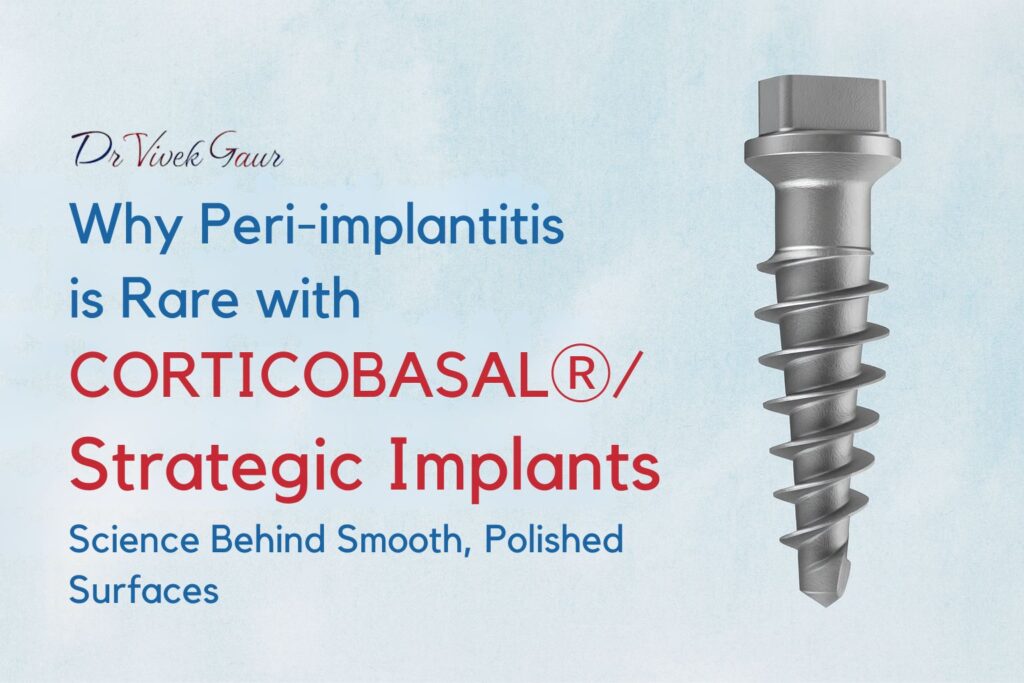
Peri-implantitis has become one of the most feared complications in conventional implant dentistry, often leading to painful inflammation, bone loss, and even implant removal. Yet, in striking contrast, clinicians using Corticobasal® Implants consistently report that peri-implantitis is almost nonexistent. The latest science behind Corticobasal® / Strategic Implants provides smooth and polished surfaces of artificial teeth.
The Science: Why Smooth Surfaces Reduce Infection Risk
Traditional implants depend on rough, sand-blasted, or etched surfaces that are designed to speed osseointegration. However, these same roughened textures act like microscopic traps where bacteria and food debris lodge easily. Once colonized, these pockets become nearly impossible to disinfect – hence the rise of peri-implantitis.
Modern Corticobasal® Implants avoid this problem entirely by using fully polished, smooth implant surfaces. Because bacteria cannot adhere effectively to polished titanium, the risk of microbial colonization drops dramatically. In fact, the systematic review clearly notes that rules used for conventional implantology cannot be applied to this newer method, precisely because the materials behave differently.
Cortical Anchorage Changes the Biology
Traditional implants depend heavily on osseointegration in spongy (trabecular) bone. This area is less dense and more prone to infection. In contrast, cortically anchored dental implants – the hallmark of Strategic Implantology – are fixated in the highly mineralized cortical bone.
Why does this matter?
- The cortical bone has a superior blood supply.
- It is far more resistant to bacterial invasion.
- Inflammation spreads more slowly – even in medically compromised patients.
- The implant stabilizes immediately, supporting immediate loading.
This is why modern dental implants, following the strategic concept, behave more like orthopedic screws than conventional implants – they are mechanically locked into strong cortical structures rather than waiting months for biological bonding.
Flapless Placement: Another Reason for Fewer Infections
The systematic review emphasizes that placing these implants is less invasive than a routine extraction. Because the procedure is flapless:
- The soft tissue is not excessively disturbed.
- Blood supply remains intact.
- Healing is fast and predictable.
- Bacterial exposure during surgery is minimal.
With less surgical trauma, diabetic, cardiac, and other patients on medications get maximum benefits. CorticoBasal® / Strategic Implantology offers the best solutions to all types of patients by maximizing strength & durability.


